21 November 2011

WEEKEND IN COLOGNE

I took advantage of being back at the clinic to have a weekend away with my old schoolfriend Catherine and see a bit more of Germany (there are no treatments on Sundays so it's generally pretty quiet at weekends). Catherine lives in Brussels so we arranged to meet in Cologne, roughly half-way between us and about two and a half hours by train from Bad Salzhausen (despite two changes, a very easy journey, thanks to the efficient German railway system). My friend Linda from Australia, a fellow patient who I'd met in July and who was back at the clinic as well, was also meeting a friend for the weekend further up the line, so we travelled together, all excited and giggly as if we were playing truant! 


Cologne's landmark cathedral, surrounded by Christmas markets

In the old town
One of the many historic breweries
Evening skyline from our hotel window


It was lovely to see Catherine, and we spent our time wandering around the old town and along the river, hanging out in cafes, catching up and talking late into the night. The Christmas markets were just starting up, the squares were lavishly decorated, and there was a great atmosphere.


Christmas lights
Even when it's alcohol-free, a beer's still a treat!

Although it was just for one night, it was great to break up the stay at the clinic with something fun, and I came back feeling like I'd had a mini-holiday. 
I keep saying I really must learn some German, but somehow I never seem to get past, "sprechen Sie Englisch?" - so it was great having Catherine as interpreter (although not so much of a holiday for her!)


4 November 2011

A YEAR ON

Sorry, there are no nice pictures on this post! It's a year ago today that I got my diagnosis, and I've found myself going over it all in my mind. I don't know if the details of that time are something that people want to read, but I feel some kind of need to tell the story, contradictions and all - perhaps partly because at the time I couldn't put into words a lot of what I was feeling and thinking, and it's only now that it feels possible. 


I'd had a CT scan the previous week and been told to come back in 6 weeks for the results, but 5 days later I got a phone call from a specialist nurse asking me to come for a biopsy. I knew that meant there must be cause for concern, and I was very scared. I went in for the biopsy 3 days later, and was met by the nurse, who told me the scan clearly showed metastases (secondary cancer) in the liver. The biopsy was to try and determine where they'd come from. 


It was the most awful news to hear, but it wasn't a complete shock - I think I'd known since the phone call that it had to be cancer. I had a lot of time to digest it, as although the biopsy was a fairly quick procedure there was a lot of waiting around first, and I had to stay under observation for 6 hours afterwards (because of the risk of bleeding). By the time that had ended it was too late to discharge me so I spent the night on a ward. In hospital you're in public all the time, so I didn't feel I could cry - instead I kind of held it all together by working out what on earth I would do. Perhaps also being on my own I didn't dare give in to my emotions in case I lost control completely. I decided I would only tell my sisters and father straight away, and that I'd give myself a week's grace, until after the results appointment, before telling close friends and work. I wasn't at all sure whether and how to tell all my various friends, relatives, colleagues and acquaintances (a huge number when I added them all up), but I did at least end up with a plan of how to get through the next couple of weeks. I eventually got discharged at midday, went home for a shower, and went straight into work for the afternoon, which was actually an enormous relief, as I could focus on other things and feel vaguely normal again.


But I knew straight away that I couldn't deal with the diagnosis while trying to maintain my work role - or cope with work while trying to take in the diagnosis - so it felt very clear that I needed to stop work once the chemo began. I coped over the next few weeks by being extremely focused on tying things up in my job, winding up therapy with all my clients, and handing over everything else which I couldn't finish in that time - I reluctantly delegated running a workshop, presenting at a national conference, and leading a concert, all of which I was due to do in the following weeks - and it felt as though a phase of my life was all-too-abruptly ending. What I didn't tell anyone was that I assumed I hadn't long to live - my mother only survived for 3 months after being diagnosed with secondary cancer in the liver, and I imagined it would be the same for me. I was never given a prognosis in terms of time (and I would have shouted down anyone who tried to predict it), but as I researched cancer of unknown primary (and later cancer in the bile duct) I couldn't help coming across the very poor outcomes. In addition, the doctors didn't want me to delay starting chemo even by a week, and in spite of their calm measured manner outwardly I picked up their sense of urgency, which was very frightening. Although I didn't articulate it to myself at the time, with hindsight I informed a lot of my acquaintances basically because I didn't want them to find out later that I'd died without them knowing I was ill.


However at another level I couldn't really believe I was dying, as I felt reasonably OK, and there was no question in my mind that I would do everything possible to improve my chances. I held onto the fact that statistics only give average outcomes, and there are always outliers who do much better than expected, and I focused completely on being one of those exceptions. As time went on, and I discovered that chemo was manageable (and, significantly, once I'd passed the 3 month point), I started to think perhaps I'd been melodramatic and misguided in fearing the worst. Although I was relieved to be feeling fairly normal, it was confusing having such a serious condition without any major change in my day-to-day functioning. It wasn't until I met Dr Herzog in June, and described my symptoms at the time of diagnosis, that he gave me some perspective by saying that if I hadn't had treatment when I did - or if they hadn't immediately managed to find a combination of drugs that worked - I would certainly not be alive now. He repeated this at my last visit: given the extent of the disease a year ago, and the aggressiveness of it, without treatment I would definitely be dead by now.


Oddly that's been reassuring to hear, as it validated my sense of how serious my situation had been (though, till recently, it felt like it would somehow have been tempting fate to put it into words). All the same, it's very hard to get my head round how lucky I've been - to respond to the initial chemo, to buy enough time to investigate a range of therapies, and to find a combination of conventional and alternative treatments which - at the moment - seems to be keeping things stable. (And of course I'm extremely lucky to be able to afford the clinic in Germany.) Superstitiously, it was only a few weeks ago that I let myself believe I would really make it to a year - and I certainly would have never imagined I'd do so in a pretty good state of health. Of course I know that things could change at any time, but all the same it's pretty incredible. In fact it's almost too big to take in at the moment - perhaps I'm still afraid of jinxing myself if I were to feel too pleased! - but it seems extremely important to fully appreciate and feel grateful for being alive and able to do most of the things I enjoy.


I don't know what this will be like to read - presumably some people will have known the seriousness of it all at the time, others perhaps not so much. But it's not easy to talk about in person (existential matters don't make very comfortable social conversation!), so it feels important to say it here. And the other thing I want to say is how blown away I've been by all the support and love I've been offered in this last year. A lot of the time I've found it quite hard to deal with - either because it reinforces how shocked and upset people have been for me, or because I haven't wanted to acknowledge that I need any help, or because I haven't really known what anyone else can do - but I am still extremely grateful for those expressions of caring. Thank you all so much. 

21 October 2011

ROUND THREE

I've returned for my third trip to the Herzog clinic, another 10-day stay. It's been lovely to re-meet some of the people I'd met before, as well as some new faces, and once again I've had some interesting and stimulating conversations. However I've also been happy to spend time on my own - reading, listening to music, writing in my journal, walking - and I've been a bit more contemplative this time than on previous visits. In London I always feel busy and pressured for time, especially since the summer when I've only had 3 weeks in between clinic visits, with lots to fit into those weeks, so it's been quite precious to be able to slow down a bit. The surroundings here are very peaceful and therapeutic, especially in the beautiful autumn weather we've had. In particular, there's lots of water, including fountains, ponds and a large installation of mineral waters flowing down over brushwood, giving off salt-laden air to inhale. I'm not sure exactly what health benefits it's supposed to yield, but it's certainly a very soothing and relaxing place. 


I had another chemoembolisation in the middle of the trip. As usual, there was a great deal of waiting around over a long and tiring day, but I was pleased to find that I was able to let go of my habitual impatience and simply accept that it would take as long as it took. Physically I found it easier to tolerate than the previous times, and I think that being in a calmer state of mind helped me to be less bothered by the discomfort and unpleasantness of the procedure. I recovered my energy very quickly the following day, no doubt helped by being given steroids, but the downside of that is hot flushes and difficulty sleeping - fortunately wearing off after a couple of days. Like last time, I'm pleased to say that there seems to have been a small improvement in the tumours, so the plan is to return for the next procedure in the second half of November. 


This time I was an out-patient for the whole visit, staying at a (different) guesthouse towards the other side of the village. I enjoyed having somewhere a bit more homely to come back to in the evenings, though the walk there and back was already getting quite bracing - definitely a touch of winter on the way!


My guesthouse

Frost in the early morning


Autumnal tree at sunrise

20 September 2011

SECOND VISIT TO GERMANY

I'm just completing my second, 10-day, stay at the clinic. It's been a bit of a mixed experience: on my first visit there I got quite a buzz from the novelty and excitement of discovering all these new treatments and talking about cancer for the first time with other people going through it - this time hasn't been quite like that, and although in lots of ways it's been great being an "old hand", it's different from that initial enthusiasm.


Sadly, 4 people I met last time have since died, which is hard to deal with. I think it's essential not to rule out hope for better outcomes than the statistics suggest (since each person responds to treatment differently and no-one can predict exactly what will happen for you personally), but all the same, accepting that the spectacular outcomes are few and far between, and that controlling the cancer for as long as possible is an ongoing commitment, is tough to get your head around. Most patients I've talked to initially hoped, like I did, that coming to the clinic would be just a one-off visit, with no need for anything further afterwards, but in fact it's just the same as it would be with any doctor: follow-up is a longterm and continuous process. Even people who are in remission come back here for regular maintenance treatments. So I'm beginning to realise that coming here will be part of my life from now on, and adjusting myself to that.


However, there have been some really good things from this visit too. It's been much easier coming back to somewhere familiar, knowing how everything works (which takes some time at the beginning!) and already knowing the (lovely) staff. I've re-met quite a few people here from last time, and it's really nice catching up with them - they're like old friends. There's a British woman here who, we discovered, went to the same school as I did (Brighton and Hove High, albeit 20 years before me), worked for a while in the same firm of consulting engineers as my father worked for, and has nieces who used to be Brownies and remember my mother! - it's been lovely finding these connections. And I've had some really interesting, stimulating, warming and fun conversations - it might sound weird that it can be so enjoyable here, but the majority of the time that's the case.


This time I stayed in one of the clinic rooms for the first 5 days and then, after a day or two recovering from the chemo, moved out to a nearby guesthouse and had the rest of the treatment as an out-patient, which works out a bit cheaper. I spend most of the day at the clinic anyhow, so it's still just as sociable, but I quite like being able to leave the building and go somewhere different at the end of the day. (And it's nice not being woken at the crack of dawn to have your blood pressure taken every morning!)


My room at the guesthouse

View from my bathroom window over the main street

In terms of treatment, as well as the daily hyperthermia and infusions, I had a second chemoembolisation procedure last week. I tolerated it better this time - I still felt pretty rough physically for a few hours, but I wasn't sick, and was much less groggy mentally. I'm sure it helped that I knew what to expect and was better prepared. I bounced back fairly quickly too - you have to take it easy for a couple of days, but 3 days afterwards a few of us hired bikes and went on a 25 km ride around local villages, among beautiful rolling countryside. It was lovely and I really enjoyed it. 


The following day I went to the thermal baths and swam gentle laps in between relaxing and floating in the wonderful salty water; since then I've made use of the clinic gym, and gone for a couple of runs in the park - my energy levels have been good and I feel better both physically and psychologically when I exercise.


Route of my morning run


The scans show a small improvement (which is encouraging, since treatment is seen as successful if it holds things stable), so the plan is to continue with a few more procedures at approximately 5-weekly intervals (staying for around 10 days each time), and see how things go. My next stay will be in mid-October, which doesn't feel very far away, but it's reassuring to have a structure for the next couple of months. And although there's lots I want to fit in at home before my return, feeling busy and focussed is definitely good!


2 September 2011

NEXT STEPS

I came home from Germany feeling much better, both physically and mentally, and spent a lovely few days with my sister Belinda, nephews, and family friends at Bwthyn Bach, our cottage in mid-Wales. 


Back in London I met my specialist nurse at the Marsden, and updated her about my treatment in the clinic. She confirmed that the medical team there are OK with me continuing to have treatment under Dr Herzog, and that they are happy to do my weekly blood tests as well as deal with any problems in between visits to Germany. Communication with doctors at the Marsden has been a bit frustrating at times, as I'm under the care of a big team and tend to see a different doctor each time.That was part of the reason I looked to the German clinic for a more personalised approach, but I've in no way cut my ties with the NHS: I pass on all correspondence and scans in both directions, and I'll have a review here, probably in October. Although the overall consultant is somewhat sceptical about therapies which don't yet have a gold-standard evidence base, I'm hoping that the UK medical team might become more interested in the German approach over time. 


In the meantime, I go back to Dr Herzog's clinic for 10 days in mid-September, for another chemoembolisation in conjunction with all the other therapies, and a review of their effectiveness, in order to plan the next phase of treatment. In any case, whether it involves more chemo or just maximising the functioning of my immune system and general health, I anticipate further visits to the clinic, and I'm very happy to transfer the active part of my care to Dr Herzog for the time being.

15 August 2011

LIFE AT THE CLINIC

To give you a feel for what it was like staying at the clinic, there are around 25 beds, plus guest rooms for friends or family to stay in (or they can be accommodated at one of the nearby guesthouses). Although there were a few German patients when I was there, most of them came from Australia and the US, with a few from the UK plus others from Vietnam, Canada, Malaysia, South Africa and eastern Europe. Everyone I met had secondary cancer, but within that there were people there at all levels of health.


The layout was comfortable and homely, with several lounges and garden areas, and a TV room, communal computer and library. There was a cafeteria for meals with a wide choice of food, always including salads and lots of fresh fruit, and tables for 4 or 5 people, so mealtimes were sociable and friendly. There was a gym (which I used a few times) and a billiards table (which I didn't, but I rather fancy for a future visit!)


Front entrance of the clinic

View from my room over the garden


The village of Bad Salzhausen exists because of its mineral waters - thermal baths and medicinal springs - which are set in beautiful parks, surrounded by forest and agricultural countryside. It's quiet and peaceful, having a population of just 500, but in the summer weekly concerts are held with lots of (mainly elderly) visitors.


Monthly market on the main street

Brass band, complete with lederhosen

Fabulous cake in a village cafe


The pretty nearby town of Nidda, a pleasant 20-minute walk away, made a nice change of scene, and I went there several times to hang out at one of the Italian cafes, browse in the shops, or go for dinner with other patients. 


Nidda town square

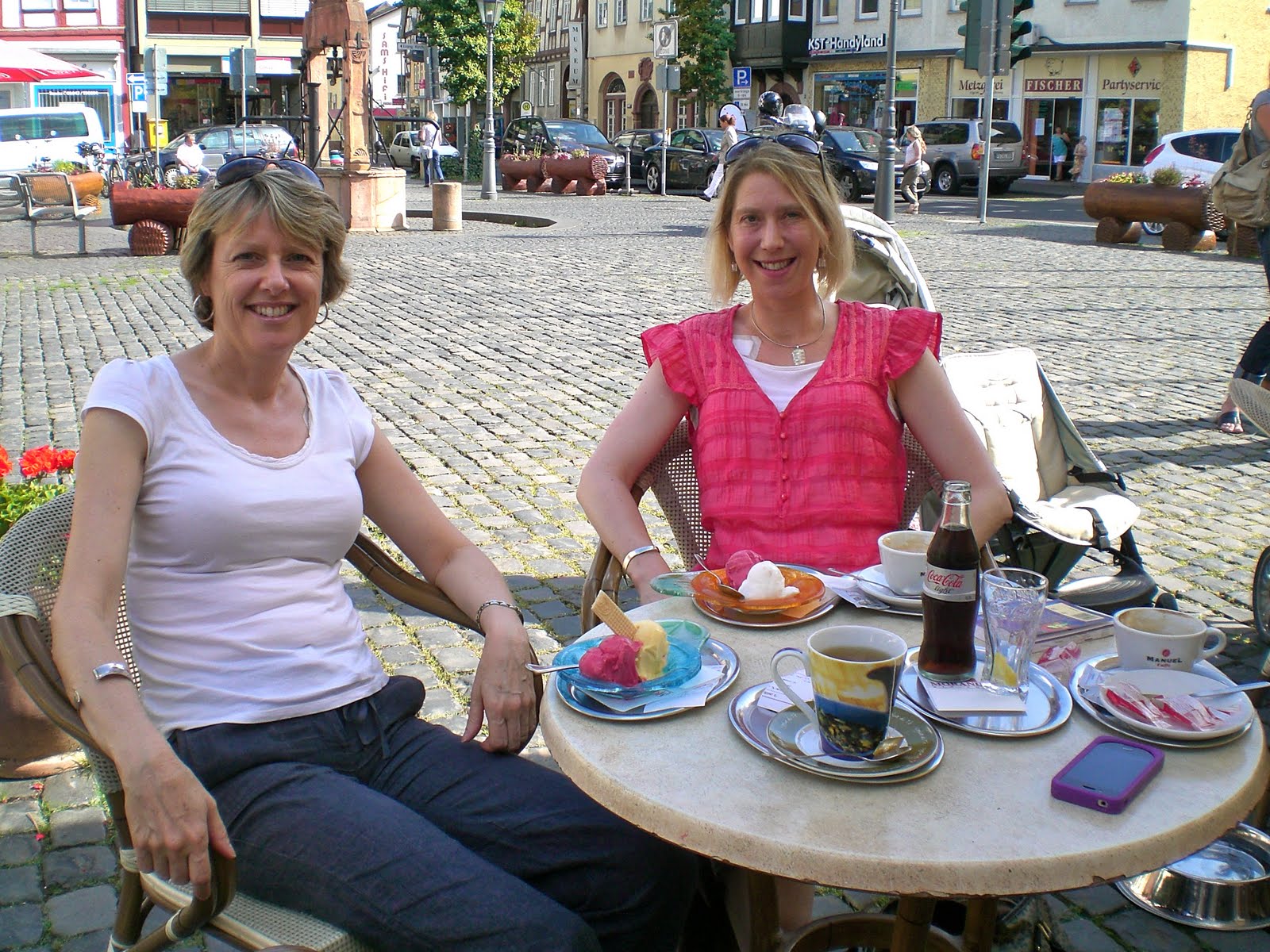
Succumbing to gelato, with fellow patient Linda

Rainbow over the cornfields on the way to Nidda


Life in the clinic was pretty sociable. Most people were accompanied by a partner, friend or relative for at least some of the time, and the atmosphere was supportive, positive and open-minded. Although I'd been a bit wary about hearing other people's stories, or talking about illness all the time, in case it became overwhelming or depressing, in fact I found it extremely reassuring and supportive to be amongst people who had all been through similar experiences and reactions to mine. It was challenging at times, and sometimes humbling, but listening to other people, and articulating things myself, helped me to clarify things and to process some of the implications of my situation. In particular, I realised just how lucky I've been in tolerating chemo so well, and to be in a good overall state of health at the moment. It spurred me to start exercising again, not so much because I feel I "should" as because I feel lucky to have the energy and strength, and I want to maintain that as much as I can. The experience of being at the clinic was quite intense in many ways, but I returned home feeling significantly more positive and emotionally grounded. 

1 August 2011

TREATMENT AT THE HERZOG CLINIC

In July and August I spent 3 weeks at this private clinic in Bad Salzhausen, a little spa village about an hour northeast of Frankfurt. The clinic offers integrative oncology, which involves conventional medical approaches alongside hyperthermia (heat) treatment - the hyperthermia not only damages tumour cells but also makes chemo more effective. I had regional hyperthermia every other day, which involved lying down under a plastic plate directing short radio waves into the liver - it heats the internal tissue but not the skin, and felt pleasantly warm, a bit like a hot water bottle and quite relaxing. The clinic also uses other new technologies like oxygen and ozone therapy (which help to inhibit tumour growth) and magnetic field therapy (which improves metabolism), and naturopathic treatments including intravenous infusions of vitamin B, vitamin C, and homeopathic remedies to stimulate the immune system and improve detoxification. I also had regular reflexology and back massages, which was lovely.


In order to make the infusions easier I had a port fitted - this is a permanent device implanted under the skin a couple of inches below the collarbone, which is connected to a catheter in one of the veins so that when the skin is pierced by a special needle infusions can be given, or blood samples taken, very easily. There's a small bump visible under the skin but it's fairly unobtrusive. The device was inserted under local anaesthetic at the hospital in the nearby town of Giessen, and although I was a bit sore and bruised for a few days after, it's healed up nicely and the scar is beginning to fade. And it's great having no more needle bruises in my wrists and arms!


In terms of chemo, the improvements seen in the spring were levelling off, and the toxicity was building up (usually people only have 6-8 cycles, whereas I'd had 9), so Dr Herzog decided to change tactics. I therefore had a procedure called chemoembolisation, where chemotherapy drugs are injected directly into the liver via the hepatic artery, and are kept in place by a temporary blocking of the artery so that they work on the tumour cells as long as possible. The advantages of this method are that a higher concentration of drugs can be used; they are targeted directly onto tumour cells; and because they're not circulated around the whole body (as happens with systemic chemo) the side-effects on the immune system (and the gut, and the hair follicles, and the other organs) are far lower. The procedure was carried out at Frankfurt University Hospital under local anaesthetic, and I was able to watch the large-screen monitor showing all the blood vessels, which I found fascinating (and helpfully distracting!). I was kept under observation for several hours afterwards, and felt pretty rough for  the rest of the day, but recovered quickly - helped by a lot of detoxing infusions. 


I felt very good on this combination of treatments, and returned to the UK feeling significantly healthier and more energetic. My morale was also lifted hugely by my hair beginning to grow again, meaning that I could have the thin wispy ends cut off and a new short style - it may be vanity but it's much easier to feel good when you look better!